REVIEW · TUK-TUK TOURS
Valencia: Tuk tuk tour
Book on Viator →Operated by Walktuk · Bookable on Viator
There is something fun about seeing a city roll by. A Valencia tuk tuk tour is a quick way to stitch together the old and new parts of Valencia without the long slog between stops.
I especially like the short time commitment and the fact that you still get real sightlines to major landmarks. The included bottled water helps too, and a good guide can turn simple photo stops into clear stories you can remember later.
The main drawback to plan for is that open-air tuk tuks can mean traffic noise and occasional sight blocks from the vehicle design, so if you hate noise or you are very tall, you may want to sit where you get the best angle.
In This Review
- Key points that make this tuk tuk tour worth your time
- Fast Highlights by Tuk-Tuk: What You Really Get in 1-2 Hours
- Serrano Towers and Sea Gate: Gothic Walls to Civil War Memory
- Turia Gardens Flower Bridge and When to Ride It
- Mestalla Stadium and the Port of Valencia: Big Landmarks With Local Energy
- Beaches Two Ways: Malvarrosa and Las Arenas Night-Ready Vibes
- City of Arts and Sciences, Central Market, and the Bullring: Modern Valencia’s Three Faces
- Estación del Norte and Quart Towers: When Valencia Looks Like a Movie Set
- Price and Logistics: Is It Good Value at $32.44?
- The Guides Matter: Names Like Tony, Salvador, and Silvio
- Should You Book This Valencia Tuk-Tuk Tour?
- FAQ
- How long is the Valencia tuk tuk tour?
- What does the tour cost?
- What’s included in the price?
- Where is the meeting point and where does it end?
- Is the tour offered in English?
- What is the maximum group size?
- Are service animals allowed?
- Is tipping included?
- What is the cancellation window for a full refund?
Key points that make this tuk tuk tour worth your time
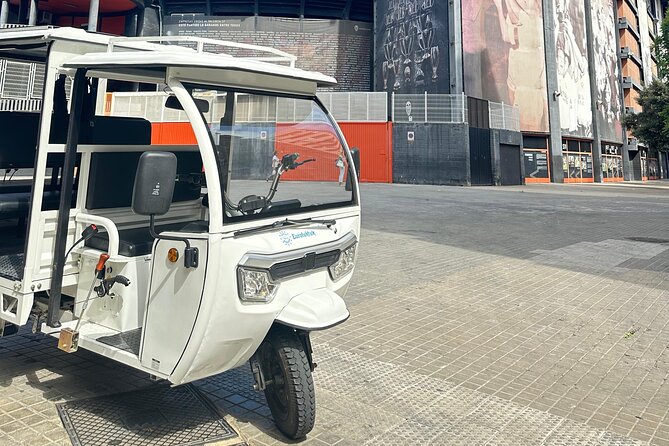
- Small-group feel (max 12) for a 1-2 hour highlights loop that is easier than pacing on foot
- A lot of Valencia in a short window, with stops covering Gothic gates, modern architecture, markets, and the sea
- Guides like Tony, Salvador, and Silvio are often praised for friendly explanations and great questions-and-answers
- Photo-friendly pace, with time built in for pictures at key spots rather than a pure drive-by
- Beach + architecture mix, so you do not leave Valencia only seeing buildings or only seeing sand
- Best timing matters in summer, since the ride is outdoors and it can get hot midday
Fast Highlights by Tuk-Tuk: What You Really Get in 1-2 Hours
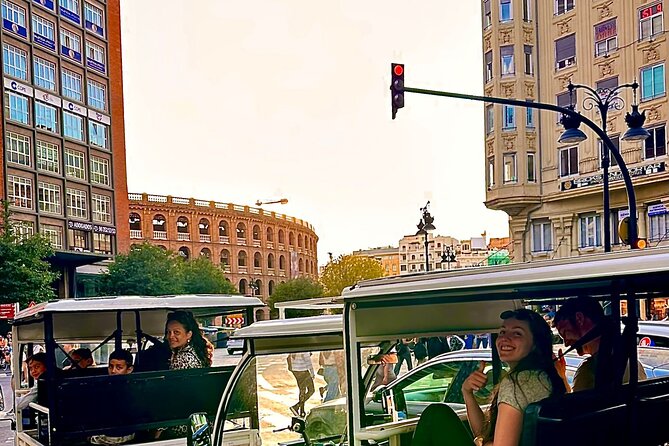
This is the kind of tour you book when your Valencia days feel too short. For about 1 to 2 hours, the tuk tuk becomes your moving base as you pass through several of the city’s most recognizable zones: medieval gates, a major stadium, the port area, big beaches, and the futuristic City of Arts and Sciences.
The value is how efficiently it strings things together. Walking works when you have time, but tuk tuk reduces the dead time between neighborhoods, and you get guided context along the way. Plus, you get one bottle of water per person, which is small but genuinely useful in warm weather.
I also like the group size cap. With no more than 12 people, you usually get a more personal vibe than the mega-bus approach, and it is easier for the guide to keep track of questions.
One thing to be realistic about: this is outdoors and exposed. If it is sunny or windy, the tuk tuk setup can help or hinder comfort, and in heavy traffic you might not hear every word perfectly. In practice, it is still a fun way to get your bearings fast.
You can also read our reviews of more tours and experiences in Valencia.



Serrano Towers and Sea Gate: Gothic Walls to Civil War Memory
A first stop like the Serrano Towers helps you understand why Valencia feels like a layered city. These medieval towers were built between 1392 and 1398 as part of the old city walls, and they served as a defensive gate. You will notice the structure right away: two large polygonal towers flanking a central arch.
What makes this stop better than a quick glance is the chance to explore the interior and climb for views. Even if you do not stay long, it gives you a vertical sense of how the old fortifications shaped the city.
Then you shift to the Sea Gate, which may look ancient but is actually a modern reconstruction. Rebuilt in 1946 to honor those who died in the Spanish Civil War, it is a white-stone reminder that monuments can be about memory, not just age. With three arches (the center is the largest), it is a clean architectural moment you can photograph without getting overwhelmed by the details.
The practical tip here is to treat these as your “architecture warm-up.” Once you have seen the gate-and-wall logic, the rest of the route makes more sense, especially when you later hit modern structures.
Turia Gardens Flower Bridge and When to Ride It
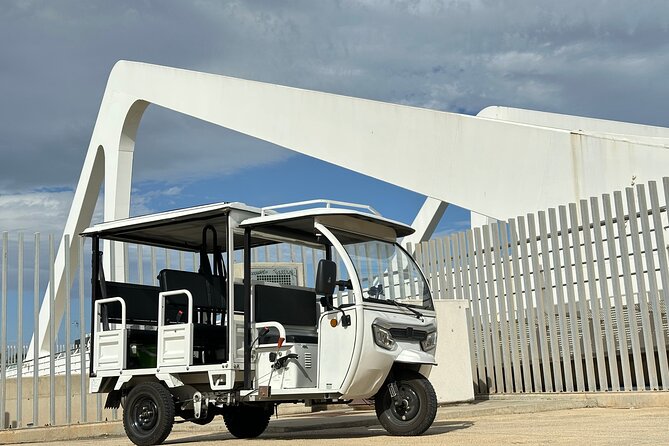
The tuk tuk route includes the signature bridge built to cross the Turia Gardens. It opened in 2002, and its whole identity is tied to seasonal flowers. Every four months the flowers change, and the bridge is often called the most expensive bridge in Valencia for that reason.
Timing matters. In September, the flowers change again, and the experience can be less photogenic than other months. If your dates line up with the transition period, I would go in with the expectation that you might be seeing the bridge in a less “photo-perfect” cycle.
This stop is also a good reminder that Valencia is not only about old stone. The Turia Gardens area shows how the city uses green space as infrastructure for people and views. From the tuk tuk, you get a good sense of where the gardens sit relative to the rest of the city.
If you are choosing a tour time, I would avoid the harshest midday heat. One of the most useful notes from past experiences is that summer afternoons can be brutal, and because your ride is open-air, shade and timing really affect how much you enjoy the tour.
Mestalla Stadium and the Port of Valencia: Big Landmarks With Local Energy

The route takes you to Mestalla, home of Valencia CF. It opened in 1923 and seats about 50,000. The stadium is designed by Santiago Calatrava, and fans love it for the steep stands that bring people close to the pitch.
Even if you are not a soccer fanatic, Mestalla gives you scale. You see how Valencia builds for crowds and atmosphere. It also makes a nice contrast to the older gates: one place is defense and passage, the other is modern gathering.
Next comes the old port, a huge million-square-meter area filled with activities. This is not just “pretty scenery.” It is where you see culture, innovation, gastronomy, sports, music, and entrepreneurship all mixed together.
A highlight here is Veles e Vents, known for its distinctive architecture and used for exhibitions and dance events. You also pass the Tinglados and the old shipyard, with lots of boat moorings and water sports operations like sailing, diving, and kayaking.
What I like about this portion is that it keeps Valencia feeling real. You are not only looking at museums and monuments; you are seeing where daily city life connects to the water.
Beaches Two Ways: Malvarrosa and Las Arenas Night-Ready Vibes
The itinerary includes two major beaches, and that matters because Valencia’s shoreline feels different block to block.
First is the most famous beach in the city, Malvarrosa. In the mid-19th century it was a flower area before it became the beach you know today. The big draw is wide, fine golden sand plus easy access to the city. It is the kind of place that looks great in photos and still works as a casual, local-friendly hangout.
Then you go to Las Arenas, named after the old fishing quarter. Locals still call it Las Arenas after the former spa, now part of a luxury hotel complex. This beach has lots of restaurants and entertainment options, and some spots naturally shift into nightlife energy later on.
In practical terms, I like these beach stops because they reset your brain. After architecture and gates, you get open space, horizon lines, and a break from stone details. In summer, it is also easier to tolerate the outdoor aspect because the beach atmosphere feels built for heat.
One caution: the ride is outdoors, so if it is very windy or very bright, you will feel it more at the beach stops. Pack sunglasses and consider how long you want to stand for photos before you get restless.


City of Arts and Sciences, Central Market, and the Bullring: Modern Valencia’s Three Faces
Valencia’s modern identity shows up big time at the City of Arts and Sciences. Construction began in 1996 and finished in 2009, designed by Santiago Calatrava with support from Félix Candela. If you love architecture, this complex is the kind of place where shapes feel like statements, not decoration.
What you get on the tuk tuk is a guided snapshot. You see why people use this area as the symbol of Valencia’s modern reinvention, and you get enough context to understand it as a designed cultural and scientific zone, not just a photo stop.
Next, the route moves to the Central Market of Valencia, opened in 1928. This is one of the oldest and most lively markets in Spain, built in modernist style with a large iron and glass dome plus colorful ceramics and ornate elements. The market started by replacing an older market square and kept a focus on fresh, local produce.
Even if you do not plan a full meal, the market stop helps you feel the city’s daily rhythm. It is a great counterpoint to the futuristic City of Arts and Sciences: one is about public culture and imagination, the other is about food that you can smell.
Then there is the Bullring, opened in 1859. It is neoclassical and inspired by the Roman Colosseum, with a circular brick structure and Doric columns. While it can host bullfighting, it also holds cultural events and concerts. That flexibility is part of why it stays on a visitor route: it is not frozen in one tradition.
If you want a “Valencia mix,” this set of stops is it. You go from visionary architecture to neighborhood life to a landmark built for huge crowds.
Estación del Norte and Quart Towers: When Valencia Looks Like a Movie Set
Two final architectural stops often make the tour feel like a mini greatest-hits album.
First is Estación del Norte, opened in 1917. It is modernist in style, designed by Demetrio Ribes, and filled with colorful ceramics and Valencian-style tiles. The station is famous for an elegant lobby and waiting area that feels dramatic in photos, and it has become a tourist attraction in its own right.
Then you end with the Quart Towers, medieval city gates built between 1441 and 1460. They were part of the defensive wall on the road connecting Valencia to the west and north. These towers are brick with gothic elements, built as two cylindrical towers linked by a wall and a large arch. They were damaged during the War of Independence and restored in the 19th century.
This pair works well at the end because it gives you “before and after” contrast: medieval defense gates on one side, rail-age modernism on the other. Your brain tends to remember the differences, and that is a big part of why this route sticks.
One practical note: because tuk tuks are open-air, if the route includes parts where buildings rise above street level, you may find some views blocked by the vehicle’s setup. In cases like that, you can still take decent photos, but you may not see everything the way you would from a viewpoint on foot.
Price and Logistics: Is It Good Value at $32.44?
At $32.44 per person, this tour prices itself as an efficiency buy. You are paying for a guided highlights loop in a small group, plus bottled water. You are also paying for speed: this is the difference between fitting key Valencia sights into a short break versus crossing the city on foot or by taxi each time.
The max group size of 12 adds value. It keeps the ride from turning into a noisy sprint, and it helps the guide handle questions while you’re moving.
You also get a few convenience items baked in:
- A mobile ticket
- A guide offered in multiple languages, including English
- Group discounts (when available)
If you are someone who hates planning and just wants to see the “main chapters” of Valencia, this kind of fixed-route tour can be a smart use of time. If you want total control—staying longer at one place, skipping another—then you might feel boxed in by the pace.
Also, do not ignore the open-air reality. In the hotter months, it can be a relief versus walking, but it is still sunny and exposed. If you can, I would aim for a morning or late-evening slot to keep it comfortable and enjoyable.
The Guides Matter: Names Like Tony, Salvador, and Silvio
One of the best reasons to pick a tuk tuk tour is the person driving it. A great guide turns quick stops into something you can carry with you.
In this specific experience, several guide names come up with positive energy: Tony is praised for being friendly, knowledgeable, and helpful with pictures, including taking great photos. Salvador is mentioned as passionate and attentive. Silvio shows up as a personable guide with clear city stories. Francisco and Sebastian are also noted for friendliness and explanations that keep the ride fun.
You should also expect that the tour is designed for interaction. One practical advantage of the small group size is that it is easier to ask questions and get real answers instead of just hearing announcements over a loudspeaker.
There is one more practical detail worth knowing. Because vehicles are limited by capacity, a group may sometimes be split across different tuk tuks while following the same general route. That does not ruin the tour, but it does mean you may not stay side-by-side with everyone in your booking party the whole time.
Should You Book This Valencia Tuk-Tuk Tour?
I think you should book if you want a short, guided Valencia highlights loop that mixes old gates, big architecture, and the sea. It is especially worth it if you are traveling with limited time, dislike long walks in summer, or want an easy overview that helps you decide where to spend extra hours later.
I would hesitate if you need silent, perfect sightlines from above street level, or if you are very sensitive to traffic noise. Also, if your schedule is tight to the minute, remember this is an outdoor route and city traffic can affect timing.
Best match:
- First-time Valencia visitors who need an overview
- People who want a comfortable alternative to walking between distant areas
- Anyone who likes architecture and beach time in the same day
FAQ
How long is the Valencia tuk tuk tour?
It runs for about 1 to 2 hours, depending on the pace of the route.
What does the tour cost?
The price is $32.44 per person.
What’s included in the price?
You get bottled water (1 bottle per person) and an English guide (with additional language options listed by the tour).
Where is the meeting point and where does it end?
The meeting point is C. de la Blanqueria, 3, Ciutat Vella, 46003 València, Valencia, Spain, and the tour ends back at the meeting point.
Is the tour offered in English?
Yes, English is one of the listed guide languages.
What is the maximum group size?
The tour has a maximum of 12 travelers.
Are service animals allowed?
Yes, service animals are allowed.
Is tipping included?
No, tips are not included.
What is the cancellation window for a full refund?
You can cancel up to 24 hours in advance for a full refund.